Saturday, March 03, 2007

Leadership #5


We can view the activity of preaching not so much as the essence of leadership but as a way in which Christ exercises his own headship. Within Paul’s letters we see the preachers of the early church fulfilling a Christ-like role in prophetic sense. In 2 Tim 2.2 Paul’s instruction to Timothy is to enlist faithful people “who will be able to teach others also.” The content of this teaching is that which Timothy heard from Paul (2 Tim 2.2), who in turn learnt it from Christ himself (Gal 1.12). This content is the “testimony about our Lord” (2 Tim 1.8); the “good deposit” which Timothy has been set apart to guard and preach (2 Tim 1.6,14). This teaching is to be done in the face of heresy and apostasy (1 Tim 1.3-4), and is the means by which the yet-to-be-perfected Church is kept faithful (1 Tim 4.16).

All this amounts to the act of preaching being understood as an outworking of Christ’s own care for the church; Jesus was a teacher and it is through his delegation of this role that he still cares for his Body. As George Herbert said in the early Seventeenth Century:

A pastor is the deputy of Christ for the reducing of man to the obedience of God.*

In particular it’s the word preached by the pastor which achieves this task. Christ still rules his church, but does so through the announcement of his Spirit empowered word.

So in the end leadership is a service we provide to help others find their place under the leadership of Christ. Planning, praying and preaching are tasks with a higher goal: the movement of people to a place under Christ’s wing. If you set your heart on being an overseer – and let’s remember what a noble task that is – then look to the Chief Overseer as the goal, model and content of your leadership. Happy leading!

* Quoted in Donald Robinson, Ordination for What? Sydney: Anglican Information Office, 1992, 29.


10 points for the following:
Top photo: Name the leader commemorated by this arch.
Bottom Photo: Name this leader-making institution.

Thursday, March 01, 2007

Leadership #4

If we understand leadership (and I should be clear: I have been speaking of church leadership) to be the practice of helping others find their place under Christ’s headship, then the practical tools and methods employed while leading must have as their goal the growth of others towards and up into Christ. Out ultimate vision is to have those under our care all the more aware of their place under Christ. Any other aim must contribute to this primary goal. Similarly, if the leadership methods we utilize do not aid us in shepherding others to a place under Christ, then we ought to reconsider the tools we employ.

As far as the leader’s character is concerned, it’s of little wonder that Paul insists that leaders display Christlike attributes. The imitation of leaders is a regular theme in Paul’s letters (1 Cor 11.1, Phil 3.17, 1 Thess 1.6), and notice that in at least two of these passages (1 Cor and 1 Thess) the imitation of leaders is linked with the imitation of Christ. Christian leaders bring others under Christ’s leadership by means of example, so godly living is a non-negotiable!

Another outcome of Christ being the Chief Shepherd is that it leaves no place for egotism. We point others to another and we encourage them to draw close to him. We do not point to ourselves nor to any charisma which we might be endowed with. It’s so easy for leaders to abuse the adoration which can flow their way; to foster a dependence within the congregation on their own particular set of abilities. Because Christ is the Chief Shepherd we should take pains to lead in ways which minimise the potential for others to develop unhealthy dependencies. Positively this means encouraging wide ranging networks where individuals are encouraged and held accountable through a variety of people. This is not to denigrate the importance of individual leadership roles, but it does place such roles within a wider communal context.

When it comes to preaching and teaching, a Christ-oriented model of leadership informs the way we view that task too…


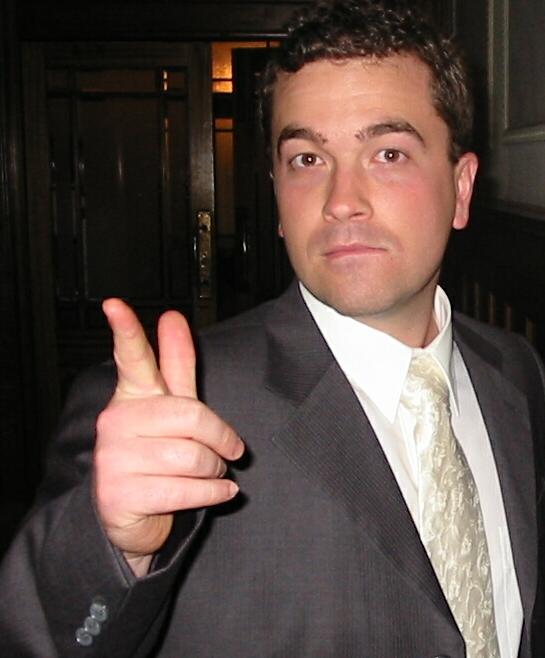
5 points to name the leader who wore this suit

Friday, February 23, 2007

Leadership #3

1 Peter 5.2-4 contains a key thought for any discussion of Christian leadership:

2 Be shepherds of God’s flock that is under your care, serving as
overseers—not because you must, but because you are willing, as God wants you to be; not greedy for money, but eager to serve; 3 not lording it over those entrusted to you, but being examples to the flock. 4 And when the Chief Shepherd appears, you will receive the crown of glory that will never fade away.

Note that there is a two-fold order of leadership here; there are shepherds and then there’s the Chief Shepherd. Peter alerts us to the fact that Christ is the true leader. Any leading which we do is done under the authority and leadership of another: the divine Son of God. Given this revelation, we can formulate a Christ-centred understanding of what we are doing when we lead:

Christian leadership is the act of helping others find their place under Christ’s leadership.

I take it that Paul had something similar in mind when he exhorted the Corinthians to follow his example, as he followed the example of Christ (1 Cor 11.1)

Of course, this view of leadership influences our understanding of those activities more commonly associated with leading, such as vision-casting and the provision of a Godly example…


10 points if you can tell me the name of the leader who wore this Harlequin cricket cap. 10 more points if you can tell me the reason why he wore it. Points are still on offer from the previous post.

Thursday, February 22, 2007

Leadership #2


Aside from the practical approach, it seems that others form their concepts of leadership with a particular emphasis on the Pastoral Epistles (1 and 2 Timothy, Titus). Echoing Paul’s emphasis on the Christian maturity expected from leaders, such discussion will have lots to say about the model of Christian maturity expected from leaders, but precious little about what leaders actually do (apart from providing a model of Christian holiness).

Those who dig a little deeper in the Pastorals will discern that Christian leadership finds an expression in the act of teaching the Word (2 Tim 2.2). This is a point well made within my own church culture (Sydney Anglicanism), so much so that from time to time you will hear the old phrase pop up that “leadership is preaching”. This is understandable given the focus we see in the Pastorals, but I have always been a little hesitant to reduce the act of leading to such a simple formula. Have we provided adequate leadership if we only ensure that a vibrant preaching programme has been put into place?

So while we don’t want to be purely pragmatic, a “purely preaching” model of leadership also seems to fall short of what is required. What we need is another approach which can unify and make sense of all these threads…

No points for picking Churchill pictured above. But 10 points are on offer if you can tell me which activity Churchill banned from his office during WWII.

Wednesday, February 21, 2007

The answer...

Watching a big ship (well done Ants and Jodi):


Who would have thought that a boat would make such a splash!

Russ and Al and I caught the Bus to see the big boat...


Al had his photo taken with the stern of the QE2...


Then we went off to find the QM2 (hard to miss really)...


And waited with everyone else to see the fireworks...


The whole thing was kinda surreal. My friend Seumas suggests that it's all about how we Aussies love a spectacle, just like the ancient Romans loved their gladiator games. The harbour is our Colosseum, and the pyrotechnician is our gladiatorial warrior. Give him the thumbs up and let him live Morris, he put on a good show!!!

Tuesday, February 20, 2007

A question...

What are these people doing?

Monday, February 19, 2007

Leadership # 1

Everybody wants to be a leader. Well, sometimes it certainly seems that way. Part of the problem is that once you work out that you want to be a leader (or more appropriately, when you discern the need for leadership around you … or when you’re thrust into an office) you’re then faced with the question of how to go about the business.


One thing I’ve noticed is that we Christians speak about leadership in different ways. Some understand it in a practical sense; the moving of people from one position to another. Methods such as “vision-casting” and “360-degree peer appraisal” are adopted from the corporate world and employed to further the Church’s goals which, of course, have been formulated to give shape to an appropriate vision statement which is just small enough to fit on professionally designed t-shirt. These goals are often about improvement and growth, and the Church’s leaders are the ones who are charged with the responsibility to achieve these goals, thereby helping the Church to execute her “ministry”.

Despite what might sound like a sarcastic tone, I actually agree with such activities. When Paul speaks of “gifts of administration” (1 Cor 12.28) he uses a word which was used in the ancient world to describe the activity of steering a boat; giving direction to a vessel and moving it from one place to another. This suggests that there is a place for developing those skills which “lead” God’s people from one place (physical or spiritual) to the next. However, others will be quick to point out that there is more to Biblical leadership than the practical ability to create change and facilitate growth…

5 points for the famous leader in the above photo.

Thursday, February 15, 2007

H*p H*p Hooray

Last Sunday night I was listening to John Safran and Father Bob on Triple J when they mentioned that the words "hip hip hooray" are a modern form of the medieval war-cry "HEP HEP hooray", where HEP is a Latin acronym for Hierosolyma est perdita, meaning "Jerusalem is lost". As such its actually an anti-Jewish rallying cry which, according to this site, was used during Jewish persecution in the early Nineteenth Century. Is this true? Maybe we'll all have to think twice after we next sing Happy Birthday...

In other news I went to this shop in Broadway today and tried on a shirt. Next thing I know the shop assistant is asking whether its OK and I'm turning around to say "yeah" only to find she's stuck her head over my change room door while I'm half naked. How very rude. That's got to be illegal or something. Afterwards she very helpfully informs me that my "colours" are chocolate, lilac and green, and that I'm to stay away from light shades of pink because there are too many pink pigments in my skin. Thanks.

Monday, February 12, 2007

Old dart #6 - Home again

5-0:
After the joys of the North I returned back to London Town for a last weekend before the flight home. The Lord's tour was fun, and also gave me a chance to gloat a little. Generally my policy in the UK was to "not mention the war", but it was a little hard not to when touring through the Lord's Museum and seeing the urn recently returned from its Australian tour. Given last night's result in the 2nd one-day final I'm now regretting my restraint; I should have made more of the opportunity.


This prayer is carved into the wall outside Westminster Abbey. I guess there are worse prayers which could be said. I especially like the last line. Inside the building is chock-a-block full of memorials, a vast contrast to the ornate but uncluttered interior of St Paul's. I also noticed that there's all this graffiti carved into the back of the royal coronation chair which is housed in the Abbey. A very human aspect to highly symbolic artefact.

Flight home:
The worst part of the whole thing. Two overnight flights in a row with five hours wandering about Tokyo airport in the middle. I was awake for almost 40 hours straight. The jet-lag took a week to get over (with the worst migraine ever) but all is better now!

Thanks for sharing in my holiday everyone (especially those who let me stay/eat in their digs: Erin, Emma and Christian in London, the Jensens in Oxford, the Waldocks in Cambridge, The Reeses in Sheffield, Izzy in Sheffield, Terry and Ruth in Edinburgh and Doug and Hannah in Dundee), Look forward to seeing you all soon.

Saturday, January 27, 2007

Old Dart #5 - More Caledonia

Dundee/St Andrews:
Sydney Uni EU people will remember Doug Forbes, the very popular Scot who came over to Sydney on exchange back in 2001/2. Since then Doug has married Hannah, and has settled in Dundee where he is doing a PhD while Hannah works as a physio. It's been good to see them, especially to finally meet the woman (Hannah) who was causing Doug so much heartbreak while he was in Oz. Full marks for persistence Dougie, she's an absolute gem!!!

St Andrews is a lovely town, one of the highlights being the ruins of St Andrew's Cathedral:


Embarrassingly, over-zealous reformers turned this magnificent and massive structure into the ruin we see today. Very sad. Points for the name of the very famous sporting club seen in the photo below, and points for the famous movie scene which was shot on this St Andrews beach.


Thursday, January 25, 2007

Old dart #4 - moving north

Sheffield:
Sheffield is crazy about cutlery. It's a town famous for it's steel, and part of that industry is devoted to the manufacturing of knives and forks and the like. I even went to a cutlery museum. Anyhow, it was great to hang out with old friends such as the Reeses:


Andrew has just started as associate vicar at Christ Church Fulwood and I had the privilege of seeing him get licenced at the evening service. He even had to swear allegiance to the Queen. HAHAHA!!!
It was also great to spend time catching up with Izzy Brook, pictured here (on the right) with her flatmate Carol. After spending 6 months in Oz back in 2005/06 Izzy went to Lebanon where she was duly caught up in a war zone as Israeli forces bombed the daylights out of the country. Her escape back to the UK makes for a hair-raising story!


Wales:
This was an attempt to trace what little UK heritage I have. My Mum's ancestors came from the North Wales coast, so I hired a car and set out to see what I could find.

Rest in Peace Thomas Thomas (1816-1875):
First stop was Rhyl, where my Great Great Grandfather (Thomas Thomas) fell off a bridge to his death while returning home from a drinking binge. I tried to find the bridge. Here it is:


According to the newspaper reports of his death he hit his head on the concrete slab seen here just above the slope before being found on the waters edge:


A sad way to go for a lonely widower.

I also drove around the Isle of Anglesea in an attempt to find the graves of further relatives, but found no tombstones that I could positively identify. Although I did find this neolithic tomb in the middle of a turnip field:


My base for the Welsh leg of my trip was a B&B in Bangor (a town known as 'Banga' to the locals), the owner of which is a lovely 73 year old Welsh lady. She was most hospitable, even to the point where she invited herself into my room to have a chat while I was wearing a towel. She then she asked to borrow £5 to pay some workmen who were doing some repairs. She paid it back. Welsh hospitality at its best.

Edinburgh:
Love it. I reckon this trip has taught me that I'm a big city kind of guy. Edinburgh has just the right amount of charm and pace. Not so big that it's pretentious, but not so small that its totally predictable. Had a fun day with MTC buddy Lynne Wilson as we checked out the vista from Calton Hill:


Terry and Ruth Johnston have warmly welcomed me into their home, which is nice given that I'm almost a stranger to them (I met Terry once in Sydney five years ago).

Tomorrow I'm heading to Dundee to see Doug and Hannah Forbes. Less than a week to go before I'm back. Getting very tired now.

Friday, January 19, 2007

Old dart #3 - Britian's other side

Earlier this week, before leaving Oxford, I was stopped in the street by a beggar. It was the usual request which you get in Sydney; "Can you spare a couple of coins..." Out of habit I said the usual "sorry", but then the woman said "Can you buy me some groceries?" Now it's a common thing for us Christians to have the policy of saying "No money, but food is ok" so I said "ok". The woman called her sister who was standing over the other side of the street and the five of us (me, two women, their two kids) went to the supermarket. Then they filled up their trolley with the absolute necessities (milk, cereal, bread) and I thought "gosh...they really are in need". I asked what the story was. Bridget said that she and her sister (Margaret) had just left their abusive Father, and were living in a one room bed-sit; seven of them in all. I looked at one of the kids and saw that he had a bath towel for a blanket. I asked what they were doing for rent, Bridget said "I don't know". So I gave them some cash to get them by until the end of the week.

Now this whole thing got me thinking about how screwed up people's lives can get, and how we can so easily walk by a beggar and think "they're a professional beggar, they don't really need this" when in fact they might actually be really desperate. As I was buying the groceries I was shocked to feel myself constantly thinking "They're ripping you off", when a sober judgment of the situation lead me to conclude that they were genuine. Now it might be possible that it was just an elaborate con to get me to buy groceries and then to get some cash at the end...but I really don't think this was the case. So what about all those other beggars who we brush so easily? Maybe it's better to risk getting conned for the sake of grace. Is this a way we can live out the Biblical concept of grace triumphing over evil? I think it might be.

Please pray for Bridget and Margaret, that they will somehow get things back on track.

Old dart #2 - I know the weather is usually bad, but...

Today 8 people died in Britain because of massive winds. I drove from Sheffield to Bangor (NW Wales), right through the worst of it. Outside Manchester this semi-trailer had been blown off its wheels and crushed a hatchback. I drove right past it; it looked really nasty. I also visited the town my ancestors came from (Rhyl on the Northern Welsh coast). It was literally too windy to get out of the car for fear of being blown into something or of having something blown into you. On the news they said that Rhyl had winds of up to 82 mph. I don't know what that is in kmh, but I know its a lot. Tomorrow should be better. And I thought Oz was meant to be a harsh environment...

Wednesday, January 17, 2007

Old dart

Since late Dec I've been in the UK. Here's the low down on the past couple of weeks, along with a couple of photos (and with a tip of the hat to all the fun and games which happen over at Byron's blog, I've decided to award points - see text for details):

The flight:
Flew to Tokyo then over Siberia into the arctic circle then down again into the UK. Amazing scenery. I had a stop over in Japan, and on the morning of my connecting flight I was having breakfast in the hotel (wearing my free RICE t-shirt ... thanks Steve!) when an Australian woman and her husband started looking at the logo and asked "What's that about...is it Christian?" I said "Yeah I'm studying theology etc", then she said "my son went to Moore...you might know him...Justin Moffatt!!!" Crazy small world we live in. The Moffatt's were coming back after visiting Justin in NY. So it was nice having breakfast with them. Jet lag was minimal. But I did crash at 10pm on NYE. Bummer. First points will be difficult...Appoximately where on the north Russian coast was this photo taken? Hint: it's near a coloured sea.

London:
What a town. I could definately live in London. The buildings are big, the pulse is ... pulsating (?!), the pace is frantic. It was cool to see some of the stuff that I've studied at uni and at college; codex siniaticus, various paintings from the old masters etc. People really know how to dress here...everything is very stylish. People also seem taller. Is that beause all the short convicts were sent to Australia? Saw Henry VIII's suit of armor. He was a fat dude. Only disapointment was the Wimbledon tour. No access to centre court (they are rebuilding) and limited behind-the-scenes moments. I was also soaked.

Old friends in London:
Had a fun afternoon and evening with Erin King And Fiona Macfarlane (Evan's sister for all you MTC people), two old friends from Sydney Uni BA days. Erin (she's the one on the left) is in publishing and Fiona is a Cambridge PhD grad in English currently working on her first novel while living in a writing commune in the US . We had really bad chinese food, but lots of laughs.

Church:
I have been to church 6 times since arriving (Gosh...that's a lot!). Maybe its because I have deliberately sought out some different experiences while over here but the English church seems to be a much more complex beast than I originally thought. An extra element which we don't seem to have a lot of back home are the charismatic evangelical Anglicans. They seem to be really moving and doing impressive things. When they find out that I'm from Sydney they all ask about Hillsong. Some even think it's an Anglican church...HAHAHAHAHA!!! Hillsong...a Sydney Anglican church...oh stop it!!! Notes on my church visits are as follows:

All Soul's Langham Place (2 visits): Rico Tice spoke both times, he's really good. Music was very professional with strings and brass sections. Perhaps a little too reserved? But I liked it nonetheless.

St Nicholas' Tooting: Smaller evangelical church in the south west of London (Erin King's church). Incredibly warm welcome. Nice mix of nationalities and ages.

Holy Trinity Brompton: The famous HTB. High energy with a real buzz around the place. I was impressed with the amount of different ministries that they carry out and the high level of lay participation throughout the church in all their activities. They also produced a very slick information brochure.

St Paul's Cathedral: Attended evensong on NYE. An unusual experience to say the least. The worshippers were at the front, while at the back many many tourists would wander in and out as the service progressed. The sermon was on the incarnation, and had a discernable evangelistic tone ("This Jesus has come into our existence to lift us out of darkness") So that was refreshing. Unfortunately the moments of clarity were accompanied by more unhelpful comments: "As Jesus came into the world in weakness, we search for him in the weak things of this world." Hmmmm...not sure those two dots are connected. Aside from the service, the building is absolutely breathtaking. This left me in two minds. Sure God is worth our architectual best, but is such building a distraction???

Oxford:
At first Oxford seems a little disapointing. Sure there are lots of old buildings but if you walk around the main streets no great vistas jump ot at you. To see the charm of Oxford you have to go searching a bit and hear some of the stories. To this end my old friend Tom Hanna wasa great help (see next section). Oxford is also a little creepy. The church were Cranmer was tried was a little sobering. It's quite dark and cold looking, and when you know that evil things transpired there it kinda gives you the creeps. The colleges look really old and in disrepair. One thing I have noticed is that in Australia we are quicker to restore our physical heritage. Perhaps we take it less for granted? More points...and I'll make you work for 'em. Which two Oxford collages can be seen in this photo? Hint: the photo was taken from Christ Church meadow.

Old friends in Oxford:
Tom Hanna (pictured with his girlfriend Sophie) gave me an entertaining and and informative night-time tour of the centre of town. It was good to see him and experience his humour again. We also had some Chinese that was much better than the stuff I had in London. Mike and Catherine Jensen have also been very hospitible. On one occasion I went shopping for long sleave shirts with Mike. HAHAHAHAHA, that's so metrosexual of us (those who know MPJ will know how funny that is, he is a well dressed man).

Cambridge:
Cambridge is much prettier on the eye than Oxford, and smaller too. The evangelical heritage in Cambridge is much more prominent than in Oxford; the Round Church have a display which focuses on the reformers and later evangelicals and they also run religious history tours around the city. The people also seem to be more relaxed. It was fun to ride a bike around the city, but my bum got really sore. Points for this famous Cambridge landmark

That's it for the first half of my trip. The second will see me move further north into Yorkshire, Wales and Scotland.

As a postscript here are two signs which I found on St Edward's church in Cambridge, a building which served as the cradle of the English Reformation. The first one shows how far we've come. Also I would have loved to have attended the 'Goth Eucharist'...how very emergent!

Tuesday, December 05, 2006

On reading and interpreting scripture

A well known preacher here in Sydney has often been heard to say that evangelicals are not in the business of “interpreting” scripture. I’ve always thought this was an odd thing to say. Surely this is exactly what we are doing when we come to a passage which is hard to understand and which doesn’t present itself with immediate clarity. Surely we are “interpreting” the text when we translate from Greek and Hebrew into English. What is this preacher talking about? Is he advocating an approach where we just respond to an unaided reading of the text, with no recourse to commentaries or other aids when trying to unlock the difficult bits?

It’s helpful to realise that we can mean different things when we talk about “interpretation”. For example, “interpretation” can mean:

1. translation;
2. uncovering the meaning of a particular text when the text is from another culture;
3. attaching meaning to a text from our own context and experience, hence providing an “interpretation”.

I think it’s this last one which the preacher in question is arguing against. It’s worth considering the difference between the last two options given above.

Often those who might oppose our reading of a text will say “That’s just your interpretation!” But as an evangelical, I don’t see myself as providing an “interpretation”. Rather I’m seeking to “read” rather than “interpret”, and this “reading” uses the tools of exegesis and history to uncover the text’s original meaning from its cultural and grammatical context. This assumes that the text has an original purpose and meaning, and that this original purpose and meaning is still worth our attention. I guess in doing this we are seeking an interpretation according to definition 2 above, but I would call this “reading” rather than “interpreting.”

On the other hand, there are some approaches which seek to remove the text from its context, leaving it as an entity in itself. This text then has meaning attached to it from modern contexts. While it’s an appealing idea to see texts “released” so that they can do many weird and wonderful things, I think that too much is lost with this approach. My fear is that we end up ‘bastardising’ the text; we leave it without an origin. And by removing the text from its origin we only enslave it to our own context; we use it to tell our own story. We may as well not play games and just say what we think, avoiding the temptation to marry our opinions to a text which we have “neutralized.” This is especially important if the original context still has very real implications which are imposed upon us. Because the NT texts were born from the context of a resurrected Lord who is still ruling and claiming his rights over us today, then they are texts which cannot be “interpreted” in separation from the ongoing rule of the risen Lord Jesus, and are also texts which still have a claim on us who live under his Lordship.

So what can we say about “interpretation”? It’s true that we must “read” the text and not “interpret” it, if interpretation means reading our own stories and experiences into a passage which has been divorced from its context. But “reading” does not simply mean “reading” like we would read a novel. It means reading with an eye to the ground out of which the text was born, a ground which saw Jesus rise from the dead and establish his ongoing rule, a rule which carries the original meaning of the NT through to our current context.

I hope all that makes some sense. It is 1.59AM after all. I guess I’m trying to tie the ongoing relevance of scripture to the ongoing Lordship of Christ. Perhaps I’ll write some more on this issue one of these days, at a more thought friendly hour.

Saturday, December 02, 2006

Exam report card

The MTC third year exams which finished last week were really hard work. I thought that nothing could be harder than second year, but I was wrong. One week later and only now am I feeling like I haven’t been hit by a truck. Here’s my take on each of the exams…

Old Testament 3 (theology)
This was our opening exam and the one which took the most preparation. The paper consisted of three compulsory questions drawn from a pool of 16 which were known to all candidates, plus one unseen question which we could pick from a number of options. Sound complicated? Yeah, not the most straightforward affair. Even though we knew the questions they were really hard and took a bit of research. This meant that while we actually learnt a lot of OT Theology, our preparation for the rest of the exams suffered. The lecturer who set the paper’s format but was on sabbatical during second semester so we couldn’t go and exact our revenge. I’m not sure how we would have done this, but some disciplinary action was necessary.

This paper receives a C.

Old Testament 3 (exegesis)
No real surprises here, but the texts which were set were only parts of larger compositional units. This made it hard to talk about structure…“This text forms ¾ of a chiasm.” Awkward.

I give this paper a B+

New Testament 3 (theology)
Again no real surprises. The questions followed the syllabus fairly closely, to the point where some questions allowed for exact regurgitations of particular set readings. The paper could have been improved by adding another question to the Pauline theology section (only three options to choose from), but the questions here were interesting enough, although predictable:

How useful is it to search for a ‘centre’ in Paul’s theology?

and

Asses the view that Paul was ‘called’ and not ‘converted’ on the Damascus road.

The New Perspective question felt a little impossible:

What is the essence of the ‘New Perspective’ understanding of Pauline theology?

This is like asking “what is the essence of being Australian” or “what is the essence of being male”. You know it when you see it (although in Newtown…), but it’s many things nonetheless.

This paper receives a B+

New Testament 3 (exegesis)
This year’s NT3 exams were both two hours in length, which I felt made the whole experience a little easier. The one common complaint was that the texts in this year’s exegetical paper were a little long, so after translation there wasn’t enough time to make adequate comments. But, the new format included a new section where no translation was required but where theological comment was asked for on a pair of related verses. Interesting.

This paper deserves an A-.

Doctrine 3
This was the paper I was least prepared for. Thankfully it was devoid of Robert Doyle’s mega-long, quotation-based questions. They were shorter and to the point, which was nice. Most people found four questions which they felt comfortable answering, but it seems that they were the same four questions for everybody. I even answered two on eschatology, which was my least prepared area in my least prepared subject.

I give Doctrine 3 a B+

Ethics 3
I worked really hard for this one. Ethics was something I struggled with all year, but I was determined to get it. I reckon it finally came to me in the days before, which is a good thing. The paper was the best of the lot; questions were stretching but accurately reflected the content of the course and enabled us to apply the skills which the course attempted to teach us. Some of the wording was interesting and betrayed certain presuppositions:

Are Christian ethics relevant to people to people who are not Christians? Illustrate your answer with reference to Old Testament Israel.

Can we call OT Israel “Christian”? Hmmm…

“Unplanned motherhood represents a threat so great to modern women that it is perceived as an equivalent to a ‘death of self’.” In a society where abortion is legal, what can Christians do to undermine its ‘attraction’?

That the Christian would want to undermine abortion assumes a certain stance, so this question can be seen to jump down the path of ethical logic a little too quickly. Nonetheless, the question of the application of a certain moral position is an interesting and important one, and it’s refreshing to break out of first order questions and to get to the pointy issue of acting upon moral theory.

Speaking of which, the last question was a real cracker and was compulsory for all taking the exam:

A cohabiting couple, who are not Christians, come to you in some distress. The woman is not yet pregnant yet yearns to have a child. The man professes to love the woman, but insists that he will leave her if she falls pregnant. They agree to several meetings with you.
What Christian moral arguments about this situation will you seek to outline and persuade the couple of, and what suggestions, advice and/or instructions about what to do will you offer?

Wow. That’s what the whole course is getting at; enabling us to actually be effective in that situation.
Well done Andrew Cameron. You get an A+.

Tuesday, November 28, 2006

Back again...again

Ok, I think I can see how this is going to work. I'll post like mad for a couple of weeks and then go all quiet for a month and a half. That's been the pattern so far; I have the desire to blog, but not the ability to carry it out. For I do not blog when I want to blog, but the non-blogging I do not want is what I keepon doing. What a wretched blogger am I! Who will deliver me from this body of Cyber-death? Thanks be to the summer holidays...

Seriously, the last 6 weeks or so has seen me in an examination frenzy here at MTC, so that's why things have been a little quiet. But posts to come include my report card on the MTC third year examination questions, more in the AIDS/HIV series, and some stuff on singleness and also some thoughts on hermeneutics. Fun fun fun!

Friday, October 13, 2006

Making room for women?

At church we've just finished a sermon series on relationships and it's raised a few questions in my mind concerning our theologies of gender.

As men, is it patronising to speak of providing a "safe" emotional and relational place for women? The biological differences between the sexes means that physically the provision of a safe place is necessary, but how much of our help do women need in other areas? At uni I was stuck in the situation where one female friend told me "men need to make room", and another said "we don't want men to make room, we need to do it ourselves and it's patronising to suggest otherwise." During sunday's sermon I addressed the men saying:

When we use affirming language, we create a relationally secure environment. Our sisters will feel that they can contribute without fear of unfair rejection or dismissal. And if we create that environment, then that's an environment where our sisters will thrive and flourish. And we want our sisters to thrive and flourish don't we? That's good for everyone, and most of al it's good for our sisters.

Was this patronising? Why should a sister have to rely on me for them to contribute to the church? Sure there's a place for encouragement, but it's not primarily up to me to give a sister confidence, surely that confidence should come first from her identity in Jesus. To suggest that she needs me to make the first move does, I fear, leave us with a sense where the woman is still subjugated in a way.

What do people think??? Do men need to make room?

Tuesday, October 10, 2006

A Christian Response to HIV/AIDS #2

I think a helpful first question we can ask concerns how we arrived at this point. What can we say about the beginning of the AIDS crisis? Perhaps if we look at the root cause we can start building a response.

A firm biological answer as to how we received this virus remains elusive. Most scientists agree that HIV is a mutated form of a similar virus found in African primates, but there is debate as to how the virus spread to humanity. Some researchers argue that African hunters who were killing and eating chimpanzees and other apes and monkeys were the first to be exposed to the virus, while others suggest that HIV was first spread by a contaminated polio vaccine which was issued to over a million people in central Africa during the late 1950s. The theory is that the vaccine was prepared using infected monkey livers in a laboratory.

However, the scriptures do give us a firm theological answer as to why we have diseases like AIDS:

We know that the whole creation has been groaning as in the pains of childbirth right up to the present time.  Not only so, but we ourselves, who have the first fruits of the Spirit, groan inwardly as we wait eagerly for our adoption as sons, the redemption of our bodies. (Romans 8.22-23)

It doesn’t take a genius to work out that there is something wrong with the world. AIDS isn’t the only symptom; earthquakes, tsunamis, cancer and human conflict all suggest that our world is not functioning as it should. In the above passage from Romans, Paul writes that the world is “groaning” under the strain of all the suffering and decay that’s going on, and we humans who are living as part of this world are groaning as well. The human race is a burdened race.

When we look back at Romans chapter 5, we see that there is one underlying cause behind all these burdens:

Sin entered the world through one man and death through sin, and in this way death came to all men, because all sinned. (Romans 5.12)

Here we see the beginning of AIDS. When our first ancestors sinned in the Garden of Eden, it wasn’t just a case of a man and his wife eating an apple. This was the point when sin and death grabbed hold of the world, setting up shop in God’s creation. And once sin and death established themselves it’s as if they vomited all over God’s good and wonderful creation, spoiling it and leaving us with things like earthquakes, cancer, human selfishness, and HIV/AIDS.

Near the university where I used to study there was this one particular Victorian-era terrace. It was fairly run down and in need of renovation, but instead of being sold to a renovator it remained empty except for some squatters who had moved in. It wasn’t long before graffiti appeared on the walls and soon all the windows had been broken. When you looked through the windows there were mattresses on the floor which were all soiled with rubbish and syringes lying about the place. What was once a beautiful and desirable creation was now ruined. You could still see and work out how the building was meant to look like, but the present reality was far from glorious. I think this is a great metaphor for our world. Sin and evil and death have moved in and they’ve made our world far from perfect, leaving us with the rubbish and soil of disease. That’s the origin of the current HIV epidemic.

Why is it important to know this origin of HIV?

1. It puts AIDS into context.
As long as there is sin, there will always be disease – its part and parcel of living in a fallen world. We may not always have AIDS – we might find a cure one day – but we will always have epidemics of one sort or another. This doesn’t mean that we just shrug our shoulders and say “oh well, nothing we can do about it, we’ll always have this issue.” Scripture demands that we respond, and we’ll get to that response in future posts, but it does mean that we don’t have to loose our heads about this. AIDS doesn’t mean that God has lost control; rather it means that God in his wisdom has allowed sin and death to remain in his world for a time. So we live in a world where AIDS is a reality, because sin and death is a reality.

2. Knowing the origin of AIDS gives us a hint as to the nature of a possible solution. Get rid of sin and death, then you rid the world not only of AIDS but of all diseases.

Our next post will take up further the possibility of a final solution.

Wednesday, October 04, 2006

A Christian Response to HIV/AIDS #1

In Australia, somewhere between 12-18,000 people are living with HIV/AIDS. Each year just under 100 people die from HIV/AIDS related illnesses, and each year sees 700-1000 new cases of HIV infection.

Once we move into the developing world though, things are very different.

The World Health Organisation estimates that 40 million people world-wide are currently infected with either strand of HIV, the worst effects being felt in Africa. In Sub-Saharan Africa, between 25-28 million people are infected with HIV. 2.3 million people die from AIDS related illnesses each year, and there are 3.4 million new cases every 12 months. Out of all the African nations, Botswana is the worst effected. Over 1/3 of all adults living in Botswana are infected with HIV. It’s estimated that because of AIDS the average life expectancy for adults in Botswana will plummet to 29 years by 2010. And of course, apart from those living with HIV, there are those family members who are affected. By 2010, it’s estimated that there will be at least 25 million African children who will have lost one or both parents to the disease.

In the face of such horrific statistics we can feel absolutely helpless; numbed by the shear enormity of the problem. Not doing anything can even seem like a viable option. Why waste time and effort on a battle you will only loose? However, as Christian people we have a hope which leads us to banish such defeatist logic:

And I heard a loud voice from the throne saying, “Now the dwelling of God is with men, and he will live with them. They will be his people, and God himself will be with them and be their God. He will wipe every tear from their eyes. There will be no more death or mourning or crying or pain, for the old order of things has passed away.” (Rev 21.3-4)

Because of the final victory of Jesus Christ we can afford to have confidence in the face of such tragedy. This post is the first in a series which will explore how we as Christians can respond to this sad epidemic which is unfolding across the globe. How can we think about this event and what can we do to help? As Christian people we are unique in the world. We follow a unique Lord and we have a unique message, so we will also have a unique response to this tragedy; we’ll have our own unique contribution to make.

I hope you find the series stimulating yet productively unsettling.

The stats in this post are from Weinreich and Benn, AIDS, Meeting the Challenge: Data, Facts, Background (Geneva: WCC Publications, 2004).